

There’s a well-known narration where the angel Jibril, sitting beside the Prophet Muhammad ﷺ, suddenly looked up at a sound from the sky and told him a gate in heaven had opened that had never opened before. Through it came an angel who had never descended to earth before either — bringing news of two things given exclusively to this ummah: the Opening of the Book (Al-Fatiha) and the final verses of Surah Al-Baqarah, with a promise that no word of either would be recited without an answered prayer attached to it.
That’s the kind of weight Al-Fatiha carries — and it’s recited, in full, at least 17 times a day by anyone praying the five daily prayers. This article breaks down what each of its seven verses actually means, why the Prophet ﷺ called it the greatest surah in the Quran, and what’s authentically established about its benefits — separate from the exaggerated claims that circulate around it.
What Is Surah Al-Fatiha?
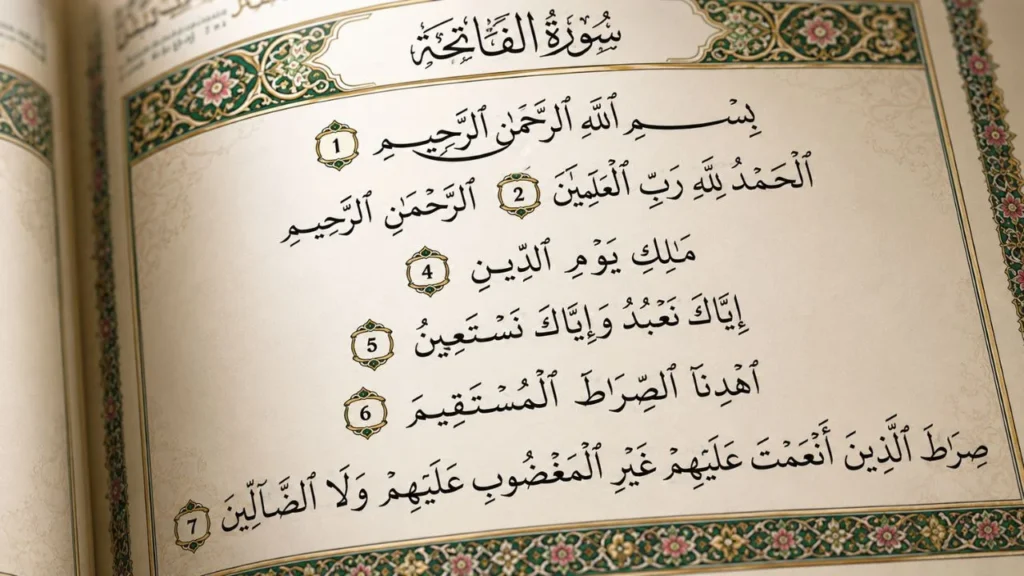
Al-Fatiha (الفاتحة) is the opening chapter of the Quran — 7 verses, revealed in Makkah, and the only surah recited in full in every single unit (rak’ah) of every prayer. Its name literally means “The Opening.” Unlike most surahs, it isn’t a narrative or a set of rulings — it’s structured entirely as praise followed by a direct request, which is part of why scholars describe it as a conversation between the worshipper and Allah rather than ordinary recitation.
It also carries several other names in classical tafsir — among them Umm al-Kitab (“Essence of the Book,” because it summarizes the Quran’s core themes), Al-Shifa (“The Cure”), and As-Sab’ al-Mathani (“The Seven Oft-Repeated Verses”), a term the Quran itself uses to describe it.
You can read the full Arabic text and translation of Surah Al-Fatiha here, with audio recitation.
The Seven Verses, Explained One at a Time
Because Al-Fatiha is short and recited so frequently, understanding what each line actually says — rather than reciting it on autopilot — is where most of its real benefit is unlocked.
1. بِسْمِ اللَّهِ الرَّحْمَٰنِ الرَّحِيمِ — In the name of Allah, the Most Compassionate, the Most Merciful. A reminder to begin any significant act by consciously attaching it to Allah’s mercy, not just as a formality but as an intention-setting statement.
2. الْحَمْدُ لِلَّهِ رَبِّ الْعَالَمِينَ — All praise is for Allah, Lord of all worlds. The surah opens with gratitude before it asks for anything — a structure worth noticing, since it teaches that praise should come before petition, not the other way around.
3. الرَّحْمَٰنِ الرَّحِيمِ — The Most Compassionate, the Most Merciful. Mercy is repeated immediately after “Lord of all worlds” — pairing Allah’s absolute authority with His mercy, so His power is never introduced without His compassion beside it.
4. مَالِكِ يَوْمِ الدِّينِ — Master of the Day of Judgment. A shift from Allah’s names of mercy to a reminder of accountability — grounding the worshipper’s gratitude in the reality that this life leads somewhere.
5. إِيَّاكَ نَعْبُدُ وَإِيَّاكَ نَسْتَعِينُ — You alone we worship, and You alone we ask for help. The turning point of the surah — Ibn Taymiyyah described this line as containing the most complete and beneficial supplication a person can make, since it combines total devotion with total dependence in a single sentence.
6. اهْدِنَا الصِّرَاطَ الْمُسْتَقِيمَ — Guide us to the straight path. The central request of the entire chapter. Notably, these are Allah’s own words placed directly on the worshipper’s tongue — He is, in effect, teaching us exactly what to ask Him for.
7. صِرَاطَ الَّذِينَ أَنْعَمْتَ عَلَيْهِمْ غَيْرِ الْمَغْضُوبِ عَلَيْهِمْ وَلَا الضَّالِّينَ — The path of those You have blessed, not of those who incurred Your anger, nor of those who went astray. The surah closes by clarifying what “the straight path” means in practice — not a vague ideal, but a path defined in contrast to two specific ways of going wrong: knowing better and disobeying anyway, or sincerely seeking truth but losing the way.

Why the Prophet ﷺ Called It “The Greatest Surah”
A companion, Abu Sa’id ibn al-Mu’alla, narrated that the Prophet ﷺ once asked if he wanted to be taught the greatest surah in the Quran before leaving the mosque — and then identified it as Al-Fatiha, describing it as “the seven oft-repeated verses and the Great Quran” given to him. This narration, recorded in Sahih al-Bukhari, is the primary basis for calling it the greatest chapter, not simply a title assigned by later scholars.
Part of what earns it that status is scope packed into brevity: in seven lines, it touches belief in Allah’s oneness and mercy, accountability in the afterlife, sincere worship, reliance on Allah, and a request for guidance — themes the rest of the Quran spends 113 more chapters unpacking in detail.
Why No Prayer Is Valid Without It
The Prophet ﷺ stated plainly that prayer is not valid for anyone who doesn’t recite the Opening of the Book (recorded in Sahih Muslim). This is why, across nearly every school of Islamic jurisprudence, Al-Fatiha is treated as a non-negotiable part of every rak’ah — the only real point of scholarly difference is whether a person praying behind an imam in an audible prayer must also recite it silently themselves.
There’s a hadith qudsi (a saying in which the Prophet ﷺ relays Allah’s own words) describing prayer as divided between Allah and His servant — where Allah responds to the worshipper after each line of the surah, acknowledging the praise, then affirming that the servant’s request for guidance will be granted. This is what elevates Al-Fatiha above ordinary recitation: verse for verse, it’s described as an exchange, not a monologue.
Its Role as a Healing (Ruqya)
One of the more striking narrations about this surah, recorded in Sahih al-Bukhari, describes a group of companions on a journey who were asked to help a tribal chief who had been stung by a scorpion. One companion, without any known background in healing, recited over him — and he recovered. When the Prophet ﷺ was later told about it, he confirmed the recitation had indeed been “Umm al-Kitab” (Al-Fatiha) and approved of the reward the man received for it.
This is the authentic basis for using Al-Fatiha as ruqya (spiritual recitation for healing) — not as a replacement for medical treatment, but alongside it, and rooted in a specific, verified incident rather than a general folk claim.
Recitation for Comfort and Guidance
Because Al-Fatiha is essentially structured as dua, many scholars point to it as the go-to surah when a person feels lost, anxious, or in need of direction — not because of a specific extra hadith attached to those states, but because verse 6 (“guide us to the straight path”) is itself a request that covers nearly every form of guidance a person could need, spiritual or practical.
A few practical ways to get more out of reciting it beyond the five daily prayers:
- Pause briefly after each verse in nafl (voluntary) prayer to let the meaning register, rather than reciting the whole surah in one breath
- Recite it with the intention of ruqya over yourself when unwell, alongside seeking proper medical care
- Reflect specifically on verse 5 (“You alone we worship, and You alone we ask for help”) during moments of stress, since it directly addresses both devotion and dependence
FAQs About the Benefits of Surah Al-Fatiha
Why is Surah Al-Fatiha called Umm al-Kitab? Because it summarizes the Quran’s core themes — belief, worship, the afterlife, and guidance — in miniature. “Umm” here means “essence” or “source,” not a literal mother, indicating that everything else in the Quran expands on what’s introduced here.
Can Surah Al-Fatiha really cure illness? There’s an authentic hadith describing it being used successfully as ruqya (spiritual healing recitation) for a scorpion sting, which the Prophet ﷺ confirmed. It’s understood by scholars as a genuine means of spiritual and, in some cases, physical healing — used alongside medical treatment, not instead of it.
Do I have to recite Al-Fatiha silently if the imam is reciting aloud? Scholars differ on this. Most Hanafi, Maliki, and Hanbali scholars hold it isn’t required when following an imam reciting audibly, while the Shafi’i school and some other scholars hold that it should still be recited silently. If you’re unsure which applies to you, it’s worth asking a local scholar familiar with your school of thought.
What does “the straight path” in Al-Fatiha refer to? The surah itself defines it in the final verse — the path of those Allah has blessed, in contrast to two ways of straying: knowingly disobeying after having knowledge, or sincerely seeking truth but ending up misguided.
Is Al-Fatiha the same as the Shahada? No — the Shahada is the specific testimony of faith (“There is no god but Allah, and Muhammad is His messenger”). Al-Fatiha is a full surah recited in prayer that contains praise, an affirmation of Allah’s authority, and a request for guidance, but it isn’t the declaration of faith itself.
Disclaimer: This article is for general Islamic knowledge and reflection. For specific religious rulings (fatwa) or personal spiritual guidance, please consult a qualified local scholar.
