

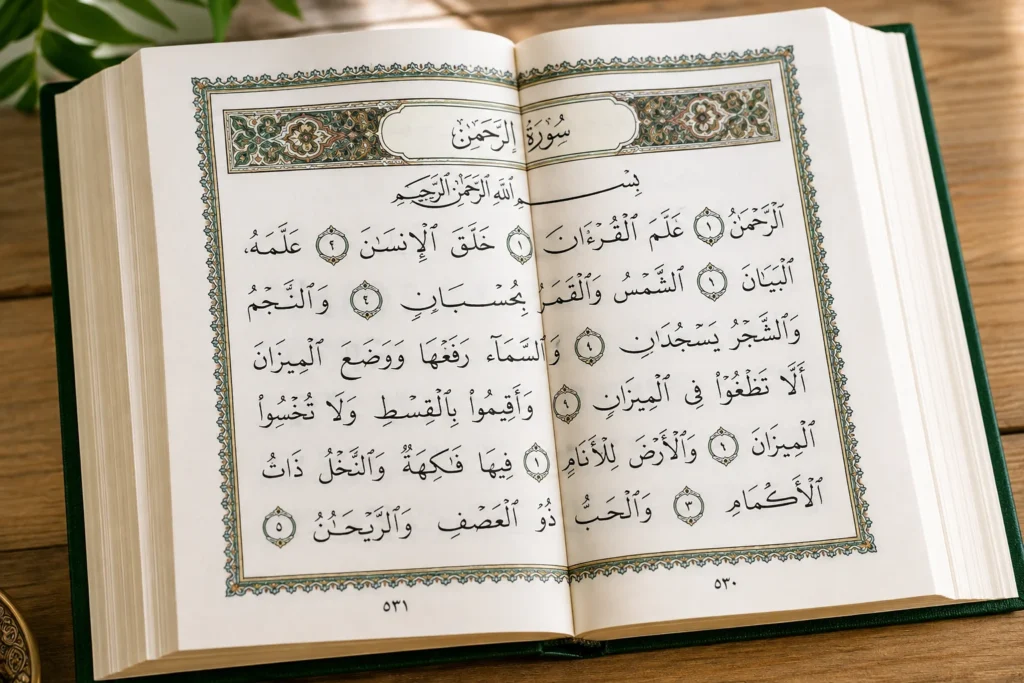
Quick Answer:
Surah Rahman (Chapter 55) is called “the Bride of the Quran” because it lists Allah’s countless blessings and repeats the verse “So which of the favors of your Lord will you deny?” 31 times. Reciting it regularly brings inner peace, gratitude, protection, forgiveness of sins, and — according to a hadith graded hasan by scholars — resembles a person who meets Allah with the beauty of His generosity on the Day of Judgment. Below, you’ll find every authentic benefit, the difference between verified and weak narrations, and the best way to make Surah Rahman part of your daily routine.
Table of Contents
What Is Surah Rahman?
Surah Rahman (سورة الرحمن) is the 55th chapter of the Quran, made up of 78 verses and revealed in Madinah, placed in Juz 27. Its name comes from Ar-Rahman, one of Allah’s most beautiful names meaning “The Most Merciful” or “The Most Compassionate.”
| Detail | Information |
| Surah Number | 55 |
| Total Verses | 78 |
| Revelation | Madani |
| Juz | 27 |
| Meaning of Name | The Most Merciful |
| Famous Title | Bride of the Quran (Arus al-Quran) |
| Repeated Verse | “Which of the favors of your Lord will you deny?” (31 times) |
You can read the full Arabic text and translation of Surah Ar-Rahman here, along with audio recitation and a free downloadable PDF.
Why Is It Called the “Bride of the Quran”?
Scholars have long referred to Surah Rahman as Arus al-Quran — the Bride of the Quran — because of how beautifully it is adorned with Allah’s blessings, much like a bride is adorned for her wedding. The surah moves through the creation of man and jinn, the sun, moon, oceans, fruits, and finally the gardens of Paradise, presenting each one as a gift the listener is asked to acknowledge rather than deny.
This isn’t a random poetic label — it reflects the surah’s unique structure. Every few verses, Allah pauses the description of a blessing to ask a direct question, pulling the reader into a personal conversation rather than a passive recitation.
The Repeated Verse and What It Teaches
The verse “فَبِأَيِّ آلَاءِ رَبِّكُمَا تُكَذِّبَانِ” — “So which of the favors of your Lord will you both deny?” — appears 31 times throughout the surah, addressed to both humans and jinn. Rather than repetition for effect, classical commentators explain that each occurrence follows a different blessing, so the question is never really the same question twice. It functions as a built-in pause for reflection (tadabbur), training the reader to notice blessings — health, rain, family, guidance — that are normally taken for granted.

15 Benefits of Reciting Surah Rahman
Spiritual Benefits
1. Builds a heart of gratitude (shukr). Because the surah is essentially a guided list of blessings, regular recitation trains the heart to recognize Allah’s favors in everyday life rather than only during hardship.
2. Strengthens belief in Allah’s mercy. The name Ar-Rahman itself is a reminder that Allah’s mercy encompasses creation before His punishment, which is why many scholars recommend this surah for anyone whose faith feels distant or mechanical.
3. Deepens reflection (tadabbur) on the Quran. The rhythmic, question-based structure makes Surah Rahman one of the easiest chapters to reflect on slowly, verse by verse, rather than rushing through recitation.
4. Reminds the reader of the Hereafter. The later verses describe both the gardens of Paradise and the consequences of denial, giving a balanced motivation to live righteously — not fear alone, and not hope alone.
Emotional and Mental Benefits
5. Brings calm during anxiety and stress. Many people report that the surah’s steady rhythm and repeated refrain have a soothing effect similar to other forms of dhikr, helping to settle a racing mind before sleep or during difficult periods.
6. Offers comfort during grief or sadness. Because it repeatedly affirms that every hardship is paired with Allah’s mercy and provision, reciters often turn to it when mourning a loss or facing uncertainty.
7. Helps rebuild a sense of purpose. Listing blessings one by one can shift focus away from what a person lacks and toward what they’ve already been given — a practice increasingly recognized even outside religious contexts as helpful for mental wellbeing.

Worldly and Protective Benefits
8. A means of seeking barakah (blessing) in daily life. Reciting it with the intention of gratitude is considered a form of worship that can open the door to ease in provision (rizq) and daily affairs, though outcomes remain entirely in Allah’s hands.
9. Recited for protection. Some scholars and communities recommend Surah Rahman alongside other protective chapters such as Surah Al-Mulk and Surah Al-Kahf as part of a daily portion of Quran for spiritual protection — though it’s important to note this practice is based on general scholarly recommendation and local tradition rather than a specific authentic hadith naming Surah Rahman for this purpose.
10. Encouraged before Friday prayer. Many communities recite it, along with Surah Al-Kahf, on Friday as part of the day’s recommended acts of worship.
Benefits Tied to Specific Hadith
11. A description resembling beauty on the Day of Judgment. Imam Tirmidhi recorded a narration in which Surah Rahman is described in relation to beauty, graded hasan (good) by several scholars of hadith, encouraging its regular recitation.
12. Called “the beauty of the Quran” (Arus al-Quran) by early scholars. While this title is not itself a hadith of the Prophet ﷺ, it was used by early generations of scholars to describe the surah’s unmatched literary and spiritual beauty.
Practical Spiritual Habits
13. A daily reminder to answer “no” to the repeated question. Some reciters make it a personal habit to mentally respond “I deny none of Your favors, O Allah” after each repetition — turning recitation into active dhikr rather than passive reading.
14. Encourages balance and justice (mizan) in daily conduct. The surah’s early verses describe how Allah has placed a mizan (balance) in the heavens and earth, and instructs people not to transgress in weight and measure — a reminder that spiritual recitation should reflect in honest, balanced dealings with others.
15. A gentle entry point into memorization. Because of its repeated refrain, Surah Rahman is often one of the easier medium-length surahs for beginners — including children — to start memorizing, since the recurring verse reinforces itself naturally.
Are the Benefits Authentic? A Note on Hadith Grading
Many articles online list “25 benefits” of Surah Rahman that promise things like curing every illness, guaranteed wealth, or a set number of angels’ protection for reciting it a fixed number of times. It’s worth being honest here: most of these specific claims are not traceable to any authentic hadith and appear in unverified compilations that circulate without a chain of narration (isnad).
What is solidly supported is the general principle: the Quran itself repeatedly promises that recitation and reflection upon it bring mercy, healing for the heart, and reward (see Surah Al-Isra 17:82 and Surah Yunus 10:57). Surah Rahman’s specific reputation as “the Bride of the Quran” and its Tirmidhi narration are the two points most scholars agree carry real weight — everything beyond that is better treated as scholarly recommendation, community practice, or personal spiritual experience rather than a guaranteed, hadith-backed promise. If you come across a claim you’re unsure about, Islamqa.info is a reliable place to check the hadith grading before sharing it further.
Best Time to Recite Surah Rahman
There’s no single obligatory time, but these are the most commonly practiced:
- After Fajr or Maghrib prayer — many people include it as part of a daily fixed portion (wird)
- On Friday, alongside Surah Al-Kahf, as part of the extra recommended worship of the day
- During times of anxiety or hardship, when its steady rhythm and reminders of mercy are most needed
- Before sleep, for those who recite a set portion of Quran as part of their nightly routine
How to Recite It for Maximum Benefit
- Start with the meaning, not just the sound. Read the translation once before or after Arabic recitation so the repeated verse actually registers.
- Pause after each repetition of “So which of the favors of your Lord will you deny?” and mentally name one blessing you’re grateful for.
- Recite with correct tajweed where possible — the surah’s rhythm is part of what makes reflection easier.
- Be consistent over intensity. A short daily portion recited with presence of heart is better than an occasional rushed recitation of the whole surah.
You can read Surah Ar-Rahman online in Arabic with translation and audio, or download the print-ready PDF to recite offline. If you’re building a daily Quran habit, our 30 Juz index and Azkar & Duas sections are good places to continue from here.
FAQs About Surah Rahman Benefits
Is it authentic that reciting Surah Rahman removes hypocrisy? No authentic, traceable hadith supports this specific claim. It appears in popular but unverified lists online. The verified benefit tied to this surah is the Tirmidhi narration describing it in relation to beauty, graded hasan by several scholars.
How many times should I recite Surah Rahman for benefits? There’s no fixed number required by the Quran or authentic Sunnah. Consistency — reciting it regularly, even a portion at a time, with reflection — matters more than reaching a specific count.
Can Surah Rahman be recited for a sick person? Reciting Quran, including Surah Rahman, for someone who is ill is a widely practiced form of comfort and supplication (dua) in Muslim communities. It should be paired with, not replace, appropriate medical care.
Why is Surah Rahman called the “Bride of the Quran”? Early scholars gave it this title because of its unmatched beauty in describing Allah’s blessings, much like a bride is adorned and presented. It’s a scholarly description, not a title mentioned by the Prophet ﷺ in an authentic hadith.
Is it better to recite Surah Rahman in Arabic or read the translation? Both matter. Reciting the Arabic carries the reward of reciting the Quran itself, while reading the translation ensures you understand and reflect on the repeated question — which is the surah’s central teaching.
Disclaimer: This article is for general Islamic knowledge and reflection. For specific religious rulings (fatwa) or personal spiritual guidance, please consult a qualified local scholar.
